The case study
The method was never the problem.
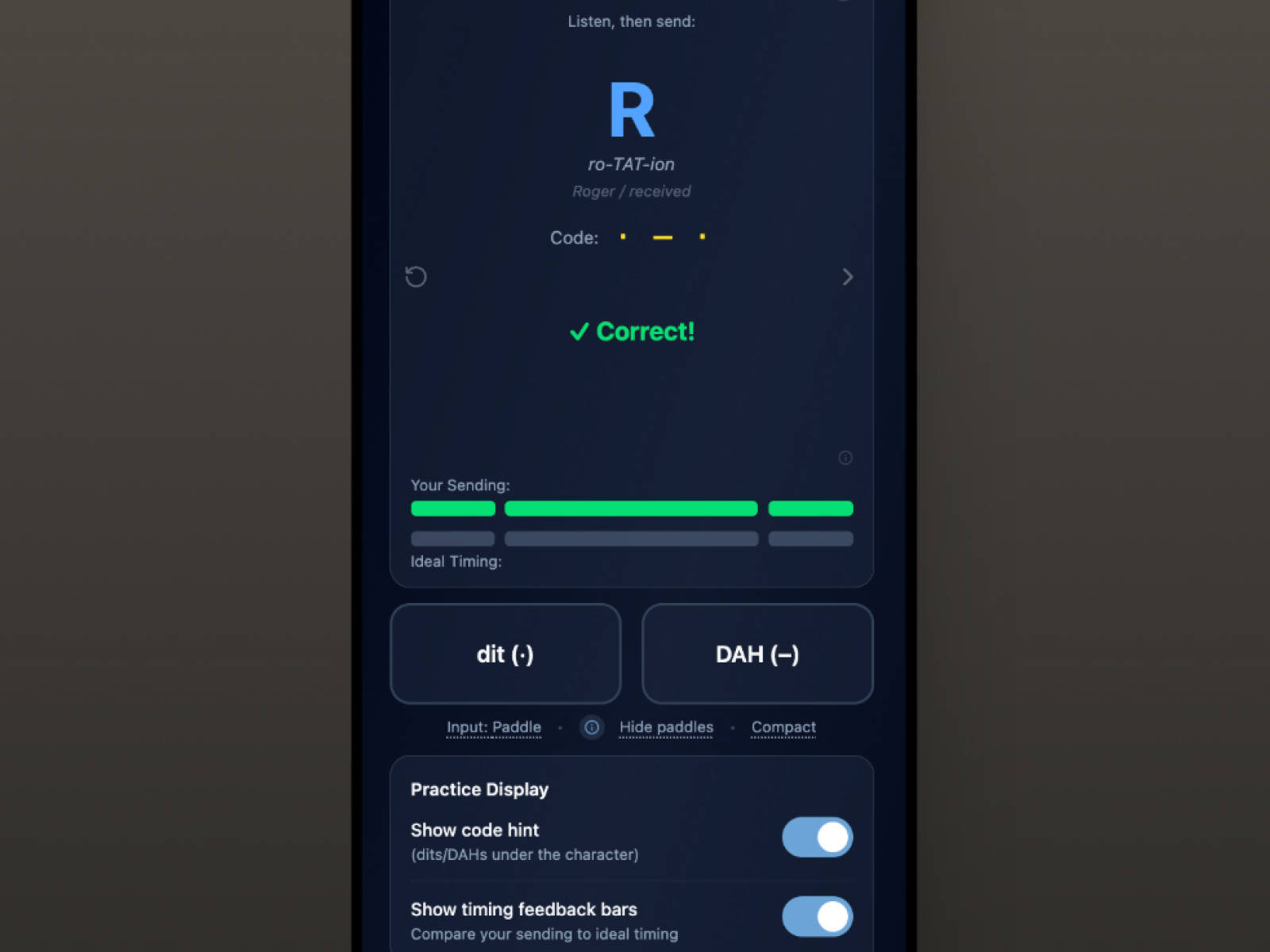
The training engine — sound-first, no visual hints.
In the 1930s, a psychologist discovered something counterintuitive about learning a complex perceptual skill. The way everyone was teaching it (building up gradually, slowing down when it got hard, memorizing patterns visually) was producing exactly the wrong kind of skill. Learners could pass a test and collapse the moment they tried to apply it in context.
His method was different. Learn at full speed from day one. Master one element completely before adding another. Build recognition, not recollection. Let the pattern become instinct.
The methodology wasn't the problem. The tools were.
What the existing tools got wrong.

Community research — the signal was clear.
A community thread asking about training tool frustrations drew thousands of views and more than a dozen substantive responses within days. The themes were consistent.
Tools that let you slow down, which feels helpful but builds exactly the wrong mental model. Speed is the point. Slowing the fundamental elements trains a skill that doesn't transfer to real application.
Tools that showed you what was coming, visual hints that let learners cheat the audio. The skill is perceptual. If your eyes can do the work, your ears never learn to.
Tools that felt like tests, not training. Score-focused. Pressure-laden. Designed around performance rather than acquisition. You could achieve top marks and still fail when it counted.
Nobody was asking for more features. They were asking for something designed around how people actually learn.
Principles before pixels.
Before any design work began, five constraints were written down. Not aspirations. Constraints. Every subsequent decision would be measured against them.
Sound first, always. The skill is perceptual. The interface must reinforce active recognition, never allow shortcuts that let learners bypass what they need to internalize.
Speed integrity. Practice always happens at target speed. A pacing technique manages content volume for beginners without ever slowing the elements themselves, enforced by the engine rather than left to discipline.
Calm over clever. No streaks. No badges. No daily pressure mechanics. No leaderboards. The platform is a focused workspace. Cognitive load belongs to the skill, not the interface.
Transfer over performance. A good score in the app is worthless if the skill doesn't transfer. Every feature is evaluated against one question: does this make the learner better at real-world application, or just better at the app?
Privacy by default. No accounts. No data transmitted. Everything local. The target community is technically sophisticated and privacy-conscious: an ethical decision that also became a strategic differentiator.
Three pillars, one architecture.

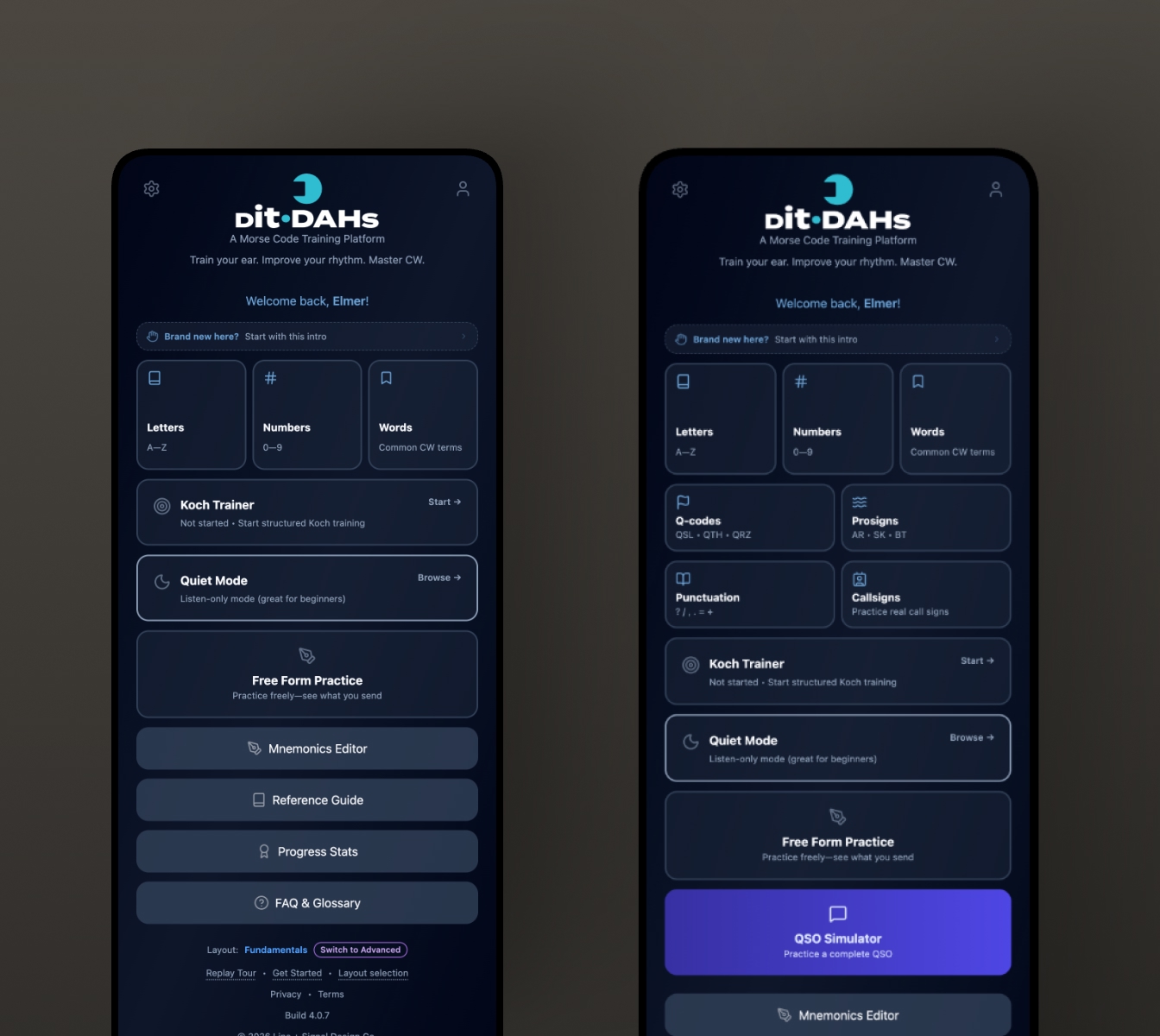
The architecture — three entry points, one skill.
The platform is built on three structural ideas that work together.
The training engine introduces content one unit at a time in a proven sequence, requires demonstrated mastery before advancement, and operates at full target speed from the first session. The learner doesn't control advancement; the engine does, based on accuracy over time. This isn't rigidity. It's the methodology working as intended.
The practice cadence system acknowledges that real learning happens in repeated short sessions, not marathon cramming. Six presets designed around real lives: different frequencies, different intensities, different commitments. The system adapts to the learner's schedule rather than demanding the learner adapt to the system.
The interaction layer bridges controlled practice and real-world application. A simulation environment that replicates authentic exchanges. A pattern recognition mode with attempt limits and reveal feedback. Hardware input support for professional-grade practice with real equipment.
Each pillar exists because of a specific pedagogical decision, not because it was a natural feature to add.
The moment the learning engine knows.

Completion modal — engine-triggered, earned recognition.
One of the most considered design decisions in the product is what happens when a learner completes the foundational training sequence.
The engine knows. It tracks accuracy per element, per session, over time. When the threshold is met, confirmed by the data rather than guessed at or self-reported, a moment is created.
Not a screen: a modal, acknowledged in context rather than via navigation. The tone is earned recognition, not celebration. This is a serious milestone for people who have worked seriously toward it. Confetti would be wrong.
The modal explains what the learner can now do in real-world application that they couldn't do before. Then it opens a door: a prompt to transition to the advanced path, where the full capability of the platform is waiting.
Non-blocking. The learner can dismiss it and continue. But the door is visible now, and it wasn't before.
Progress that belongs to the learner.

Completion certificate — generated locally, no server.
There are no leaderboards. No social comparison. No external benchmarks.
Progress is stored locally, on the device, in the browser, under the learner's control. The platform never sees it. It can't be compared to anyone else's. It can be exported, shared with an instructor, or kept entirely private.
When the full training sequence is complete, the platform generates an achievement credential: locally, in the browser, without a server. The verification logic runs on the device, so the credential is valid whether or not the platform is still online. It belongs to the learner completely.
Your achievement, verified. No account, no server, no expiry.
The interface gets out of the way.

The interface at its most intentional — almost invisible.
Every design decision in this product points in the same direction: toward the skill, away from the interface.
No visual hints during active training. No way to slow down to a speed that feels comfortable but builds the wrong model. No score that flatters performance while ignoring transfer.
Just the pattern. The recognition. The feedback.
When the tool gets out of the way, the learning begins. That's not a design principle. It's the whole point.
Outcomes
The platform launched to a private beta cohort advancing through a 43-level training sequence with no accounts, no server, and no external dependencies. Return frequency and advancement rate are the primary behavioral signals. Both are positive early indicators. The locally-generated achievement credential is verifiable without an active server connection: one of the few in the category that requires no account to verify and no platform to remain online.
When a tool becomes a teacher, the interface earns its invisibility.
One question led to another...
If the learning system should build real-world communication skill, what should the physical act of practicing actually feel like?